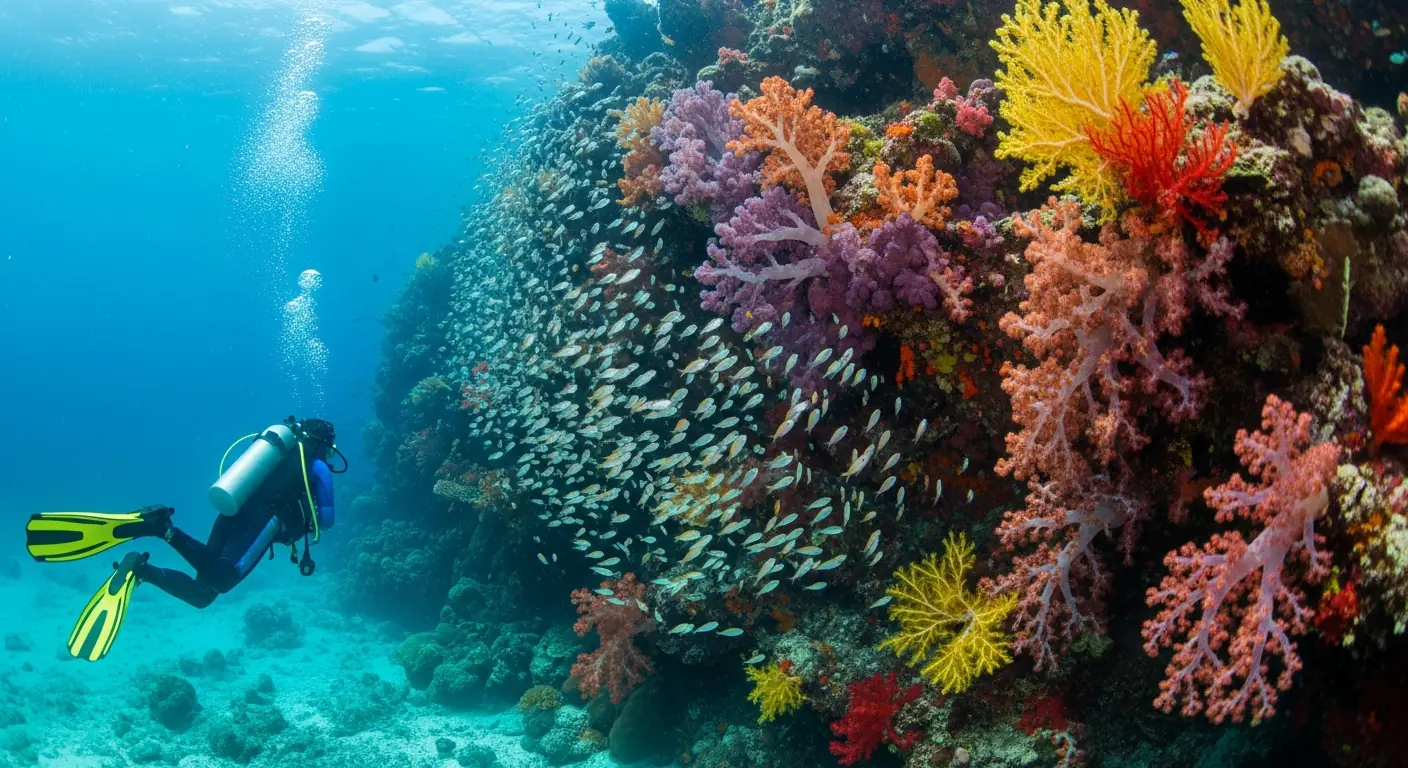
The water around Wakatobi is a constant invitation, a liquid sapphire with an average visibility of 30 metres. Below the surface, the coral structures rise from the deep, intricate and vibrant, illuminated by sunlight filtering through tropical waters that consistently register between 28 and 30 degrees Celsius. This region, defined by its coordinates between 5.2° and 6.2° south latitude and 123.3° and 124.6° east longitude, is a convergence point for marine life, where the Pacific and Indian Ocean currents meet, fueling an ecosystem of extraordinary complexity.
Diving the Wakatobi UNESCO Marine Park Reefs
Wakatobi National Park, designated in 2002, protects an area of approximately 13,900 square kilometres, encompassing diverse marine habitats. This vast expanse ensures a range of dive experiences, from shallow coral gardens to dramatic wall dives dropping into the abyss. The park’s protection status has fostered a remarkable preservation of its coral ecosystems, which are among the most biodiverse on Earth. Divers encounter an extraordinary array of hard and soft corals, forming intricate structures that serve as habitat for thousands of species. Specific dive sites within the park, such as House Reef and Roma, are celebrated for their density of fish life and coral health. The consistent water temperatures, averaging 28 to 30 degrees Celsius, support this rich biodiversity year-round, making every dive a comfortable exploration. Visibility, commonly around 30 metres, allows for comprehensive observation of these complex interactions, from the smallest nudibranchs to schooling pelagics. The Wakatobi Regency, with a recorded population of 111,402 people at the 2020 Census, manages this natural resource with a focus on sustainable tourism, ensuring the reefs remain pristine for future generations of divers and marine scientists.
Coral Reef Wall Diving in Wakatobi
The topography of Wakatobi’s underwater landscape is characterized by dramatic coral reef walls that plunge into significant depths. These vertical structures are often adorned with sponges, gorgonians, and various species of anemonies, creating a living canvas for marine life. Wall diving here offers a different perspective, revealing the intricate layering of the reef ecosystem. Divers drift along these walls, observing schools of bannerfish and fusiliers, while moray eels and groupers inhabit the crevices. Macro photographers find endless subjects among the crinoids and ascidians clinging to the rock face. The sheer scale of these walls, often extending hundreds of metres, provides a sense of immersion in a truly grand natural system. The clarity of the water, consistently around 30 metres of visibility, enhances the experience, allowing divers to appreciate the depth and verticality of these environments. These walls are not merely geological features; they are vibrant, living communities, constantly evolving and supporting an incredible density of species.
Sulawesi Marine Biodiversity: A Scientific Perspective
Wakatobi’s position within the Coral Triangle, a global epicentre of marine biodiversity, underpins its scientific significance. The region’s unique oceanographic conditions, influenced by currents from both the Pacific and Indian Oceans, contribute to an exceptional species richness. Scientists have identified thousands of fish species and hundreds of coral species within Wakatobi National Park, which covers approximately 13,900 square kilometres of land and sea. This makes it a critical area for marine research and conservation efforts. The annual sea temperatures, averaging between 28 and 30 degrees Celsius, provide optimal conditions for coral growth and the proliferation of diverse marine fauna. From pygmy seahorses camouflaged on gorgonian fans to large pelagic fish patrolling the deep, Wakatobi offers a microcosm of the Indo-Pacific’s marine life. The clarity of the water, with an average visibility of 30 metres, facilitates detailed observation and underwater photography, allowing researchers and photographers to document this biodiversity effectively. The Wakatobi Regency, with its population of 111,402 people (2020 Census), recognizes the importance of preserving this natural heritage. Further information on the region’s broader context can be found at Wakatobi National Park on Wikipedia.
Liveaboard and Resort-Based Diving Logistics
Diving in Wakatobi can be experienced through both liveaboard vessels and resort-based operations, each offering distinct advantages for experienced divers. Liveaboards provide access to the most remote dive sites within the 13,900 square kilometres of Wakatobi National Park, allowing divers to explore areas less frequented by day boats. These vessels typically offer multiple dives per day, including night dives, maximizing underwater time. Resorts, on the other hand, provide a land-based luxury experience with daily boat dives to nearby reefs. Both options cater to underwater photographers with dedicated facilities, rinse tanks, and charging stations. The consistent sea temperatures, averaging 28 to 30 degrees Celsius, and excellent visibility, commonly around 30 metres, ensure comfortable diving conditions regardless of the chosen platform. Planning for a Wakatobi trip involves considering the duration of stay, preferred diving style, and specific marine life interests. The Wakatobi Regency, situated between 5.2° and 6.2° south latitude and 123.3° and 124.6° east longitude, is accessible via domestic flights from major Indonesian hubs, connecting divers to this remote marine sanctuary.
Tropical Water Diving Conditions and Best Season
Wakatobi offers consistent and favourable diving conditions throughout much of the year, characteristic of its tropical location. Annual sea temperatures consistently average between 28 and 30 degrees Celsius, eliminating the need for thick wetsuits for most divers. Underwater visibility commonly averages around 30 metres, providing expansive views of the reefs and marine life. While Wakatobi experiences a dry season and a wet season, diving is generally excellent year-round. The dry season, typically from April to October, is often preferred for calmer seas and minimal rainfall, optimizing surface intervals and travel comfort. However, the wet season can also offer excellent diving, often with fewer divers at popular sites. The Wakatobi National Park, established in 2002, covers approximately 13,900 square kilometres, and its sheer size and diverse topography mean that protected dive sites are often available even during less favourable weather. Divers should consult with their chosen liveaboard or resort for specific seasonal recommendations and to confirm operational schedules. The consistent conditions make Wakatobi a reliable destination for planned trips, attracting divers globally to its pristine waters. Additional geographical context for the region can be found at Wikidata Q796206 and Wakatobi Regency on Wikipedia.
Underwater Photography in Wakatobi
Wakatobi is recognized as a premier destination for underwater photography, appealing to both amateur and professional image-makers. The exceptional water clarity, commonly averaging around 30 metres of visibility, provides ideal conditions for wide-angle and macro photography alike. The vibrant coral reefs, teeming with a diversity of fish and invertebrate life, offer an endless array of subjects. From intricate nudibranchs and tiny pygmy seahorses for macro enthusiasts to schooling fish and dramatic reefscapes for wide-angle shots, the opportunities are abundant. The consistent tropical water temperatures, between 28 and 30 degrees Celsius, allow for extended bottom times, crucial for capturing compelling images. Many liveaboards and resorts in Wakatobi are equipped with dedicated camera rooms, charging stations, and rinse tanks, catering specifically to the needs of underwater photographers. The rich biodiversity, supported by the 13,900 square kilometres of protected area within Wakatobi National Park, ensures that every dive presents new photographic possibilities. Understanding local currents and marine life behaviour enhances photographic success, allowing photographers to anticipate interactions and capture unique moments. For further information on the administrative division, refer to Wikidata Q1034404.
To further explore the unparalleled diving opportunities and planning resources for your Wakatobi adventure, continue your research on wakatobiscuba.com.